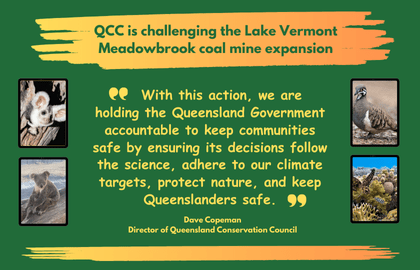
The Queensland Conservation Council (QCC) has lodged a formal objection in the Queensland Land Court against the proposed extension of the Lake Vermont Coal Mine, citing serious environmental concerns—including the project’s significant contribution to climate change.
Bowen Basin Coal Pty Ltd is seeking approval for its Lake Vermont Meadowbrook Extension Project, which involves the development of a new underground mine and a satellite open-cut pit across more than 8,000 hectares in Central Queensland.
Conservation groups warn the project would destroy critical habitat, increase greenhouse gas emissions, and further damage an already degraded landscape.
Dave Copeman, Director of the Queensland Conservation Council, said:
“Queenslanders are already facing more intense and frequent natural disasters, driven by fossil fuel emissions. This project would only deepen the climate crisis and inflict unacceptable harm on our environment and communities.
“The mine would destroy over 100 hectares of endangered koala and greater glider habitat. Instead of bulldozing nature for coal, we should be protecting and restoring it to build resilience against climate change.
“With the Great Barrier Reef experiencing the worst mass bleaching on record, the last thing we need is a new coal mine polluting the Fitzroy Basin and Reef catchments. This project threatens not only local ecosystems but one of the world’s most iconic natural wonders.”
Dr Coral Rowston, Director of Environmental Advocacy in Central Queensland, added:
“We are very pleased that QCC is taking on this legal challenge. This coal expansion would clear over 8,000 hectares of land—displacing threatened species and destroying ecological communities in a region that has already lost nearly 80% of its original vegetation.
“The Lake Vermont Meadowbrook project is projected to emit more than 340 million tonnes of greenhouse gases. That’s a devastating carbon footprint that would worsen climate change impacts on species, ecosystems, and regional communities.
“If governments are serious about climate action, they must stop approving new high-emitting coal projects. Legal action is always a last resort, but it has become the only remaining path to defend our environment and future.”
Legal action is always a last resort.
It’s costly, time-consuming, and something groups only pursue when:
- We’ve exhausted all advocacy options – submissions, political engagement, and even direct talks with project proponents.
- Legal experts confirm there’s a strong case and a real chance of making change.
- There’s access to legal and financial support to see it through.
If you can, QCC would appreciate any assistance in helping to fund this case!
 EnvA - CQ