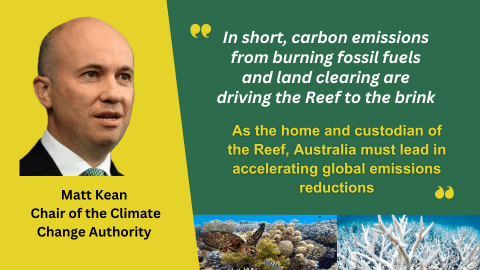
Australia must act urgently to reduce greenhouse gas emissions or risk losing the Great Barrier Reef, Climate Change Authority Chair Matt Kean warned at the recent 2025 Australian Meteorological and Oceanographic Society Summit in Cairns.
Mr Kean confirmed the Authority is preparing a major report on threats to the Reef, with early findings underscoring escalating risks from ocean warming, acidification and intensifying extreme weather.
“In short, carbon emissions from burning fossil fuels and land clearing are driving the Reef to the brink,” Mr Kean said.
The Great Barrier Reef is home to 1600 fish species, over 450 types of coral, and 900 types of algae and seagrass. It supports endangered species such as the dugong and six of the world’s seven turtle species – many of which are of deep cultural significance to First Nations communities.
But climate models show stark futures. If global warming exceeds 1.5°C, 70 to 90% of the Reef is forecast to decline. At 2°C, up to 99% of coral systems may be lost or fundamentally altered.
“No barrier on emissions will mean virtually no Great Barrier Reef – it’s as simple as that,” Mr Kean said.
The economic costs are equally sobering. The Reef supports thousands of jobs and generates billions in economic activity annually. Yet, the global emissions trajectory is heading toward 2.8°C warming – well above the safe thresholds.
Last week, Earth System Science Data confirmed 2024 as the hottest year on record, 1.52°C above pre-industrial levels. The pace of warming has increased to 0.27°C per decade over the past 10 years.
Oceans have borne the brunt of this warming, absorbing 93% of excess heat and 30% of carbon dioxide emissions. That’s equivalent to 3 billion tonnes of CO₂ annually – or pollution from 650 million petrol cars.
Australia’s waters have recorded their warmest or second-warmest temperatures for every month since July 2023, contributing to widespread coral bleaching and habitat destruction.
Warmer oceans also intensify weather extremes. Recent back-to-back cyclones in northern Queensland triggered 700-kilometre-long flood plumes, depositing sediment across coastal ecosystems. Sea temperatures now support tropical cyclone formation further south than ever before.
“As the home and custodian of the Reef, Australia must lead in accelerating global emissions reductions.
“If Australia co-hosts the COP31 climate summit with our Pacific neighbours, we have a unique opportunity to demonstrate that leadership,” Mr Kean said.
A transcript of the full speech is available here.
 EnvA - CQ