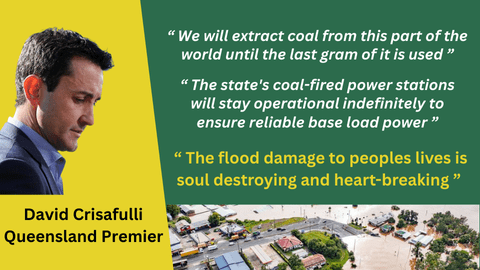
The Queensland Government is preparing a new 5-Year Energy Roadmap and reviewing its pre-election promise to cut emissions by 75% by 2035 and reach net zero by 2050.
Despite this commitment – reaffirmed as recently as election day – the government now appears to be shifting its energy focus toward cost control, energy reliability, and prolonging coal use as a primary energy source. The Queensland Productivity Commission has been tasked with leading this review.
Environmental Advocacy in Central Queensland Director, Dr Coral Rowston, said:
“It is beyond belief that our State Government is determined to keep Queensland dependent on coal and gas long into the future.
“Premier Crisafulli’s statement that he wants to ‘extract coal from this part of the world until the last gram of it is used’ flies in the face of climate science – and of Queensland, Australian and global emissions reduction targets.
“It is also ludicrous to suggest that keeping coal-fired power stations operating past their planned retirement dates will lower electricity costs. The costs of maintenance will only increase, as will the price of recovery from more frequent and severe weather disasters.”
Queensland has allocated $1.4 billion over the next five years to maintain government-owned power assets, including coal-fired stations. Independent analyses show that just one plant, Callide B, could cost $420 million a year – enough to deplete this budget in little over three years.
Another power plant, Callide C, has also experienced multiple catastrophic failures in recent years with the private company that owns half of the power plant now under administration because the costs of keeping aging coal fired power stations open is high.
Dr Rowston added:
“The Queensland Government seems intent on burning taxpayer dollars to prop up deteriorating coal plants rather than investing in a clean energy future.
“In just the first six months of government, Premier Crisafulli witnessed devastating floods across northern, south-east and western Queensland – events that come with a high price tag. Continuing to fuel climate disasters is not a sensible path forward.
“We call on the Queensland Government to invest in a safer climate future, not on outdated assets that harm our communities and environment.”
 EnvA - CQ