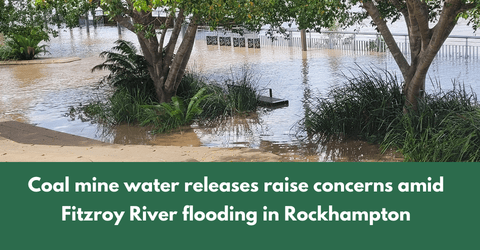
Environmental Advocacy in Central Queensland (EnvA) has raised concerns about the role of coal mine water releases contributing to flooding in the Fitzroy River, with potential impacts on local communities, river health, and the Great Barrier Reef catchment.
Central Queensland has experienced record rainfall in the first weeks of the year, resulting in devastating impacts to towns, infrastructure, livestock, and the natural environment.
EnvA Director Dr Coral Rowston said the organisation has been closely monitoring coal mine water discharges since the heavy rainfall began earlier this year.
“We already know that coal mines are major contributors to greenhouse gas pollution, which is driving more frequent and severe weather events. During these heavy rain periods, many mines then release large volumes of stored, contaminated water into already flooding catchments.”
Dr Rowston said the scale of releases is significant.
“The volumes of polluted water being discharged into the Reef catchment are extraordinary, with some coal mines releasing thousands of litres per second,” she said.
“On 15 January, 19 Bowen Basin coal mines reported released water from 26 release sites at a combined rate of well over 123,000 litres per second – I struggle to convert this to the number of litres released each day.”
EnvA says the additional volumes of water and associated contaminants raise serious concerns for downstream communities and sensitive ecosystems.
“This extra water is highly likely to be adding to flooding impacts downstream and does nothing to protect the quality of water flowing into the Great Barrier Reef,” Dr Rowston said.
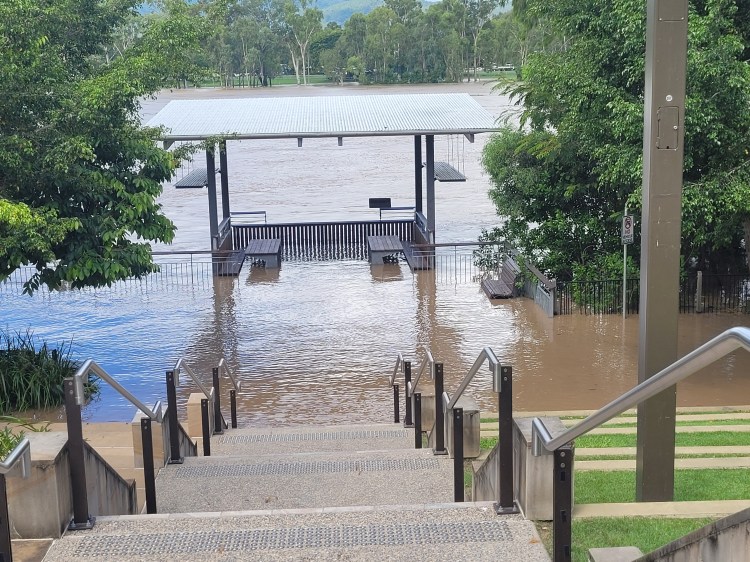
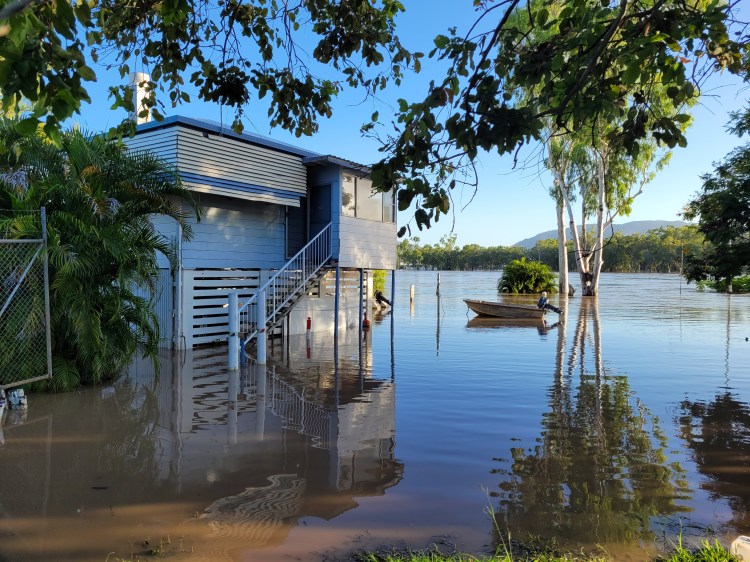
Rockhampton is already experiencing minor flooding, with moderate levels expected in the coming days. Authorities estimate that around 280 properties may be affected. However, EnvA says the full environmental impacts on river ecology and marine ecosystems are yet to be assessed.
“Isn’t it time we listened to the science?”
“Extreme weather events are costing communities emotionally and economically — through loss of homes and livelihoods, rising food and insurance costs, and the burden of disaster recovery.
“Coal and gas projects are fuelling climate change, and in these events, they are also directly contributing to flood risks and water pollution,” said Dr Rowston.
Ensham Coal – one of the coal mines currently releasing water
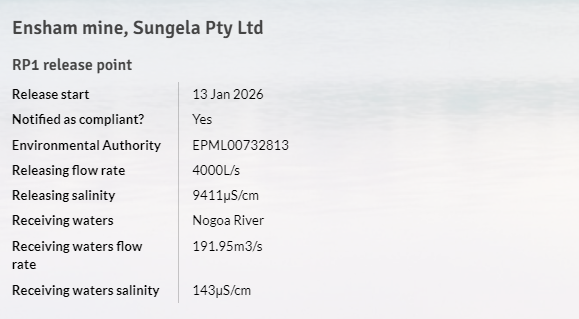
EnvA says recent reporting from the Ensham Coal Mine raises serious questions about transparency and compliance.
According to publicly available data, water releases were first reported on 13 January at rates of approximately 4,000 litres per second, with salinity levels reported at more than 68 times that of the receiving waters in the Nogoa River.
The Ensham mine was previously impacted by major flooding in January 2008, when at least two pits were inundated with more than 100,000 megalitres of mine water.
That event led to changes in legislation allowing controlled releases to enable the mine to resume operations.
Despite operator statements that levee banks installed after 2008 would protect the mine if flooding reached similar levels, EnvA notes that this does not necessarily mean contaminated mine water would be fully contained, as releases may still be authorised under environmental approvals.
EnvA says reported water releases at Ensham were listed as “compliant” between 13 and 15 January 2026, but that status changed on 16 January.
“The coal mine water release information suddenly changed on 16 January for the Ensham mine,” Dr Rowston said.
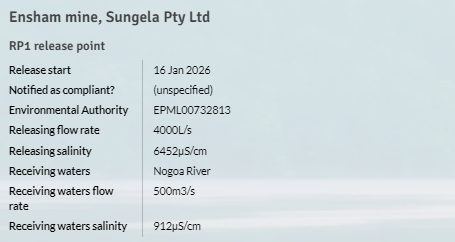
“The water releases were no longer listed as ‘compliant’ with their Environmental Authority despite no change to the releasing flow rate.
“The salinity levels of released water was lower, but the salinity levels of the receiving waters of the Nogoa River had increased significantly .
“The transparency of water releases must be improved. This is water that supports our agricultural sector and our urban water supply.
“We expect the Queensland Government to be actively investigating this issue. The last thing communities need during a flood is polluted floodwater and a water supply that is not fit for purpose.”
Impacts of the flooding on the Great Barrier Reef
It is well understood that the greatest threats to the Great Barrier Reef are climate change, sedimentation and poor water quality.
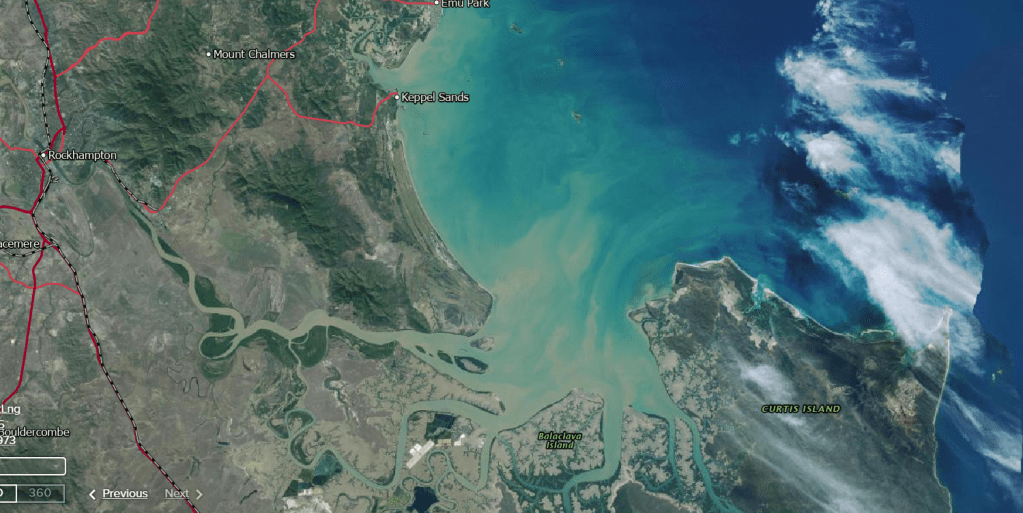
The current flooding event is contributing to sediment and pollutant plumes moving toward the Reef, driven by high rainfall across the catchment and additional discharges from coal mine water releases.
“Australians depend on the Reef for tourism, fishing, and recreation — sometimes for our livelihoods, and sometimes simply for enjoyment,” Dr Rowston said.
“The ongoing impact on the Reef from warming sea levels and the polluted water coming out of waterways can largely be placed on the fossil fuel industry. Our agricultural industry has been heavily regulated, but the fossil fuel industry has been given a free run.
“The science is clear — we do not need any more coal and gas projects. Australia already produces more than enough to meet domestic energy needs and existing export commitments, without placing further pressure on communities and the environment.”
 EnvA - CQ