As the Federal Government rolls out the most significant reforms to Australia’s national environment laws in more than two decades, Environmental Advocacy in Central Queensland (EnvA) says the success of the changes will hinge on whether new national standards genuinely prevent further environmental decline — or simply repackage a system that continues to approve damaging projects.
The reforms to the Environment Protection and Biodiversity Conservation (EPBC) Act, prompted by the landmark Samuel Review, aim to replace broad discretion with clear, enforceable national environmental standards covering Matters of National Environmental Significance (MNES) and the use of environmental offsets. The goal is to restore trust in federal decision-making, improve consistency across projects, and halt the ongoing loss of threatened species, ecosystems and critical habitat.
EnvA has welcomed the intent of the reforms but warns that the draft standards, as currently written, fall short of delivering the “quantum shift” in environmental protection that the Government has promised.
EnvA Director Dr Coral Rowston said:
“The State of the Environment Report makes it clear that nature in Australia is in decline.
“If the new standards are not strong, clear and enforceable, we will continue to see projects approved that contribute to habitat loss, declining water quality and worsening climate impacts, particularly in regions already under intense development pressure.”
EnvA is particularly concerned that both the MNES and Environmental Offset standards rely on language that leaves too much room for discretion. Terms such as “should”, “if possible” and “have regard to” appear throughout the draft instruments, which the group says undermines certainty for proponents, decision-makers and the community.
“National standards must require compliance, not just consideration. Otherwise, we risk keeping the same system under a different name,” said Dr Rowston.
A major focus of EnvA’s submission on the Offset Standard is the continued reliance on biodiversity offsets to justify significant environmental damage. The group argues that offsets in Australia have a poor track record and often fail to deliver genuine, long-term gains for threatened species and ecosystems.
“Even the Federal Environment Minister has acknowledged that current offset arrangements are broken and making nature worse.
“In heavily cleared and developed regions like Central Queensland’s Brigalow Belt, there is simply not enough suitable land left to offset the impacts of new and expanding coal and gas projects.”
EnvA says offsets should only ever be used as a last resort, after all impacts have been avoided and minimised, and that projects should be refused where suitable, secure and ecologically meaningful offsets cannot be found.
The group also raised strong concerns about the lack of clear requirements to assess cumulative impacts on MNES. In Central Queensland, multiple coal and gas projects often affect the same threatened species and ecosystems, including koalas and greater gliders, which have recently been reclassified as endangered.
“Assessing projects one by one ignores the reality on the ground.
“Many small slices of the cake will still eventually result in no cake.
“Without a strong, landscape-scale approach to cumulative impacts, we will continue to see the steady erosion of nature,” said Dr Rowston.
Another key issue identified is the absence of clear definitions for critical concepts such as “critical habitat” and “unacceptable impacts”. EnvA argues that without these definitions, decision-makers retain broad discretionary powers, weakening the purpose of having national standards in the first place.
On environmental offsets, EnvA is particularly opposed to the idea of allowing proponents to pay into offset funds when suitable land-based offsets cannot be secured.
“Nature is not something you can ‘pay to destroy’. If a project cannot proceed without causing unacceptable harm to threatened species or ecosystems, then it should not proceed at all.”
EnvA is calling on the Federal Government to strengthen the draft standards by making them outcomes-based, mandatory and enforceable, requiring robust assessment of cumulative impacts, clearly defining key terms, and significantly limiting the role of offsets in approving environmentally damaging projects.
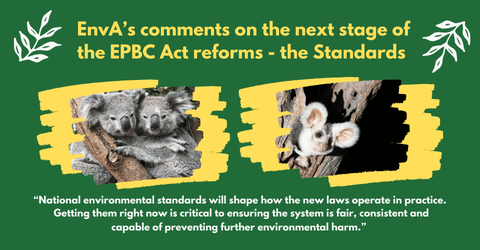
“National environmental standards will shape how the new laws operate in practice,” said Dr Rowston.
“Getting them right now is critical to ensuring the system is fair, consistent and capable of preventing further environmental harm — not just managing its decline.”
 EnvA - CQ