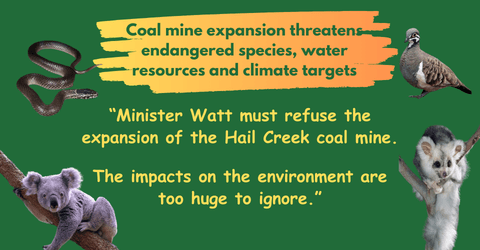
Environmental Advocacy in Central Queensland (EnvA) has called on the Federal Environment Minister to refuse approval of Glencore’s proposed Hail Creek Open Cut – Eastern Margin Extension, warning the project would cause unacceptable harm to endangered wildlife, water resources and the Great Barrier Reef, while worsening climate impacts.
The proposed expansion would clear around 680 hectares of land, including nearly 600 hectares of remnant vegetation, in a region already heavily fragmented by coal mining and agriculture. EnvA says the impacts cannot be assessed in isolation given the cumulative damage already inflicted on the northern Bowen Basin.
EnvA Director Dr Coral Rowston said:
“The proponent admits this project will result in significant residual impacts on endangered koalas and vulnerable squatter pigeons.
“It will also destroy high-quality habitat for greater gliders, ornamental snakes and threatened Brigalow Belt ecological communities and waterways.”
EnvA has raised serious concerns about the reliability of the environmental surveys used to justify the project, noting they were conducted between 2012 and 2015, prior to the re-listing of the koala and greater glider as endangered and the expansion of coal mines in the northern Bowen Basin.
“These surveys are more than a decade old and don’t reflect current conditions.
“Recent independent drone surveys have identified large numbers of koalas in the project area, suggesting this population may be nationally significant.”
The proposed clearing would also sever habitat within a Statewide Biodiversity Corridor connecting to Homevale National Park, with Glencore claiming the loss of connectivity would be ‘temporary’ until rehabilitation occurs in around 20 years.
“That claim simply doesn’t stack up,” said Dr Rowston.
“Leaving permanent final voids and relying on uncertain rehabilitation means habitat loss and fragmentation would be long-term and irreversible for endangered species.”
Water and Reef at risk
The expansion would permanently alter local hydrology, including the diversion of 1.5 km of Hail Creek, construction of new levees and drains, and the creation of additional final voids.
EnvA says mine water discharge estimates provided by the proponent appear inconsistent with recent high-volume releases, raising concerns about compliance risks — particularly as climate change drives more intense rainfall and flooding events.
“These waterways flow directly into the Great Barrier Reef catchment.
“More mine water discharges mean poorer water quality for the Reef, on top of the growing threat from climate change.”
A super-emitting coal mine
EnvA also highlighted Hail Creek’s history as a major methane emitter, with recent reporting showing a dramatic increase in fugitive emissions.
“Approving an extension to one of Australia’s highest methane-emitting coal mines is completely inconsistent with Australia’s climate commitments and the global methane pledge.”
The project would add millions of tonnes of greenhouse gas pollution, including emissions from thermal coal, despite Glencore’s stated commitment to reduce its thermal coal portfolio.
Offsets are no substitute for protection
EnvA has strongly criticised the reliance on biodiversity offsets to justify the project, arguing that offsets cannot replace habitat critical to the survival of endangered species — particularly where proposed offset areas are already occupied by the same species.
“Damage to nationally protected species should not be for sale.
“If a proponent cannot avoid or properly offset the destruction of critical habitat, the project should not proceed.”
Call for refusal or full assessment
EnvA is calling on the Minister to determine that the project would have clearly unacceptable impacts, or at a minimum require a full Environmental Impact Statement under the EPBC Act.
“This project would worsen biodiversity loss, undermine water security, add fuel to climate change and increase risks to the Great Barrier Reef.
This is the first real test of the revamped national environmental legislation and whether it makes a difference for our environment,” said Dr Rowston.
“The only responsible decision the Minister can make is to refuse it.”
 EnvA - CQ