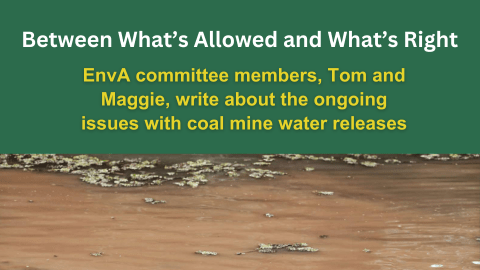
A different way to express EnvA’s concerns about coal mine water releases and the failures of our legislation in protecting our environment.
Prepared by Tom Sjolund and Maggie Inglis
The creek used to run clear enough that you could count the stones on the bottom.
Tom remembered that. He said it often, usually while standing on the low bridge just outside town, staring into water that now moved thick and slow, the colour of weak tea. People smiled politely when he said it, the way you do when someone insists on remembering a version of the world that no longer quite exists.
But the truth was, everyone remembered something like it.
Maggie didn’t grow up here, but even she could tell the river wasn’t right. She’d arrived fresh out of university, idealistic and stubborn, clutching a job title that sounded more powerful than it was: Environmental Compliance Officer. It came with a desk in a prefabricated office, a stack of legislation thick enough to stop a door, and a quiet instruction from her manager:
“Do your job. Don’t make trouble.”
At first, she thought those were the same thing.
The mine sat beyond the ridge, out of sight but never out of mind. You could hear it at night sometimes – low rumbles, the metallic grind of machines chewing into earth. It had approvals, of course. Pages and pages of them. Conditions, offsets, management plans, monitoring requirements. It all looked airtight on paper.
Maggie read those documents carefully. The language was precise, confident. Impacts would be “managed,” biodiversity “offset,” water quality “maintained within acceptable limits.”
She believed it. At least, she wanted to.
Until she started doing site visits.
The first time she saw the sediment plume, it was almost beautiful. A pale cloud spreading through the creek, curling and unfurling like smoke underwater. She stood on the bank, boots sinking into damp soil, and watched it drift downstream.
“Within limits,” the site supervisor told her, glancing at his clipboard. “We’re compliant.”
She checked the numbers later. He was right.
The legislation didn’t say the water had to be clean. It said it had to stay within a range. A permissible level of harm. A line drawn not at “no damage,” but at “not too much damage.”
Maggie wrote her report. She used the same words she’d read in the approvals: “within allowable thresholds,” “no exceedance recorded.”
It felt like translating reality into something softer, more acceptable.
Weeks passed. Then months.
She learned how it worked.
If clearing habitat was unavoidable, it could be offset somewhere else – land protected on paper, often far away, sometimes already degraded. If a species was at risk, there were plans: surveys, monitoring, contingencies. If water was polluted, there were limits and triggers and responses, all carefully structured.
Everything had a process. Everything had a framework.
And everything, somehow, still kept getting worse.
One afternoon, Maggie visited Tom at the bridge.
“You work for the government, don’t you?” he asked, not unkindly.
“I do,” she said.
“Then why’s the creek like this?”
She hesitated. She could have explained the approvals, the thresholds, the compliance reports. She could have talked about balancing economic development with environmental protection.
Instead, she said, “Because what’s allowed isn’t the same as what’s right.”
Tom nodded, as if that confirmed something he’d always suspected.
Back at the office, Maggie started noticing the gaps.
The legislation was strong in parts—on paper, it could stop projects, impose strict conditions, demand accountability. But in practice, it bent under pressure.
Projects were assessed one at a time, as if each existed in isolation. The slow accumulation of impacts—the way one mine became two, then ten—was harder to capture, easier to ignore.
Enforcement was reactive. Regulators waited for breaches, then responded. But if the rules themselves allowed harm up to a certain point, there was often nothing to enforce.
And the system depended on information provided by the very companies it regulated. Reports, models, predictions—complex, technical, and rarely challenged in depth due to limited resources.
Maggie realised something uncomfortable: the system wasn’t exactly broken.
It was doing what it had been designed to do.
The turning point came during a public consultation session.
The room was half full – locals, a few activists, company representatives in neat shirts. Maggie sat at the back, listening.
A woman stood up. She spoke quietly but firmly.
“You say the impacts are acceptable,” she said. “But acceptable to who?”
No one answered directly.
The project manager talked about jobs, about economic benefits. A consultant mentioned mitigation measures. A government official referred to the rigorous assessment process.
The woman sat down, unsatisfied.
Maggie felt something shift.
The legislation had been written to weigh competing interests, to find a balance. But the scales were uneven. Economic arguments were immediate, tangible. Environmental losses were often long-term, uncertain, easier to discount.
And once something was approved, it was very hard to undo.
That night, Maggie rewrote a report.
She didn’t change the data. She didn’t break any rules. But she stopped softening the language.
Instead of “minor impact,” she wrote “ongoing degradation.”
Instead of “within acceptable limits,” she wrote “persistent pollution permitted under current standards.”
Instead of “offset,” she wrote “habitat loss not replaced in like-for-like conditions.”
It wasn’t a rebellion. Not really.
But it felt like telling the truth.
The report didn’t stop the mine. It didn’t change the legislation. It didn’t clear the river.
But it circulated.
People read it. Some dismissed it. Others didn’t.
And slowly, conversations began to shift.
Months later, Maggie stood on the bridge again.
The creek was still murky. The changes were not dramatic, not yet. Systems like this didn’t transform overnight.
But upstream, there were new monitoring requirements. Stronger conditions. A review underway.
Small things.
“It’s still not how it used to be,” Tom said.
“No,” Maggie agreed. “But maybe it doesn’t have to stay like this either.”
He looked at her, curious.
“What changed?” he asked.
Maggie thought for a moment.
“The rules didn’t,” she said. “Not really. But how we use them might.”
The creek moved on, carrying its silt and its stories.
And somewhere between what was allowed and what was right, people had started to notice the difference.
Note: Tom and Maggie confess that AI assisted them to put this story together. It is a fictional story based on their mutual concerns about how legislation is not protecting our environment – particularly in relation to coal mine water releases.
 EnvA - CQ