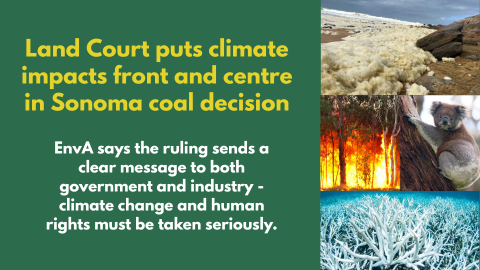
Climate change and human rights have taken centre stage in a landmark Queensland Land Court decision on the proposed Sonoma East coal mine expansion.
The Queensland Land Court this week handed down its decision in QCoal Sonoma Pty Ltd & Ors following a challenge by Environmental Advocacy in Central Queensland (EnvA) and two landholders to the Queensland Government’s 2023 approval of an environmental authority and mining lease.
While Land Court President Peta Stilgoe ultimately recommended that the mining lease be granted, she also called for stronger climate accountability – recommending that the Environmental Authority be amended to require a greenhouse gas emissions reduction plan with specific and measurable targets.
EnvA Director Dr Coral Rowston said the decision marked another important step in recognising the real-world impacts of climate change.
“We would have preferred that the Sonoma coal mine expansion was refused, but we welcome the Court’s clear acknowledgment that climate change impacts human rights,” Dr Rowston said.
The Court reaffirmed that public interest considerations extend well beyond the immediate project area, encompassing communities across Queensland and requiring a careful balancing of benefits and harms.
Despite the Sonoma Coal Mine being classified as a medium to high emitter under Queensland’s Greenhouse Gas Emissions Guidelines, the Court found the proponent’s emissions reduction approach lacked substance.
President Stilgoe noted that projected emissions reductions appeared to stem largely from declining production as the mine nears the end of its life—rather than any deliberate mitigation efforts.
She was critical of the company’s lack of firm commitments, stating:
“QCoal has not committed to an absolute emissions reduction target… [and] has not identified any specific targets… nor outlined any actual steps that it is taking.”
“The steps towards GHG emissions reduction are aspirational rather than concrete.”
The Court also made clear that regulatory frameworks such as the Safeguard Mechanism do not remove the obligation on proponents to take meaningful action on emissions.
“The Applicants cannot rely on the Safeguard Mechanism to absolve itself from taking practical, measurable steps to reduce its GHG emissions,” President Stilgoe said.
In a pointed response to the Department of Environment, Tourism, Science and Innovation’s assertion that the project was compatible with human rights, the Court stressed that decision-makers must do more than offer broad assurances.
“A comment of this nature is unhelpful,” President Stilgoe said.
“A public entity… is required not just to decide whether the decision is compatible with human rights but to identify what rights may be affected, and whether those rights are limited.”
The Court reiterated that any increase in greenhouse gas emissions contributes to climate change and may engage the fundamental right to life.
While acknowledging an ongoing demand for coking coal, President Stilgoe noted there was no clear evidence presented regarding the need for thermal coal from the project.
She described the case for approval as marginal, stating that the recommendation to grant the mining lease was finely balanced and influenced by the project’s relatively small scale and status as an extension of an existing operation.
Importantly, the Court also highlighted shortcomings in the proponent’s evidence, noting that key issues were not addressed in sufficient detail.
Despite these gaps, President Stilgoe concluded there was enough material to justify approval – subject to the critical condition that a robust, measurable emissions reduction plan be developed.
Dr Rowston said the ruling sends a clear message to both government and industry.
“This decision reinforces that climate change and human rights must be taken seriously in project approvals.
“If coal projects are to proceed, they must be backed by real, measurable commitments to reduce emissions—not vague promises.”
 EnvA - CQ