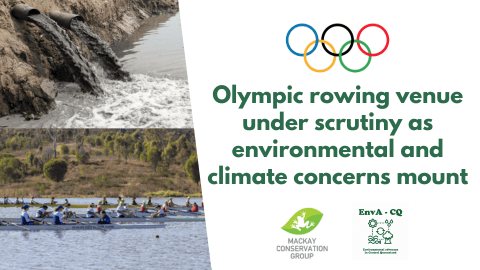
The Queensland Government’s plan to host flatwater rowing and canoeing events for the 2032 Olympic and Paralympic Games on the Fitzroy River is facing growing criticism, with concerns spanning environmental damage, safety risks and long-term economic value.
The proposal would see Rockhampton’s Fitzroy River transformed into an Olympic-standard venue – requiring significant dredging, widening and modification to ensure consistent water flow. Critics argue the site is unsuitable due to its natural characteristics, including its susceptibility to flooding and its status as a habitat for saltwater crocodiles.
The plan has also drawn concern from within the sporting community, with hundreds of Olympians reportedly questioning whether a crocodile-inhabited river is an appropriate venue.
Despite these concerns, Central Queensland conservation groups say the biggest issue is not the presence of crocodiles—but the environmental impact of the works required to make the river suitable.
Mackay Conservation Group Climate Campaigner Imogen Lindenberg said living alongside crocodiles is part of life in the region.
“We live in crocodile country and have no concerns about rowing and canoeing events operating in croc-country while organisers promote a croc-safe approach.
“The Rockhampton Fitzroy Rowing Club regularly uses the Fitzroy River for events and training, and school groups have also used the site for rowing regattas.
“The initial and ongoing dredging and disturbance of the Fitzroy is of more serious concern”, Ms Lindenberg said.
She warned that sediment disturbance from dredging would not stay local.
“The sedimentation and disturbance will flow through the Fitzroy River mouth and directly into the waters of the World Heritage-listed Great Barrier Reef.”
The controversy comes amid broader questions about Queensland’s commitment to delivering a “climate-positive” Games.
When Brisbane secured the 2032 Olympics, it was widely promoted as the world’s first climate-positive Games—a commitment aligned with the International Olympic Committee’s requirement for Games from 2030 onward to go beyond carbon neutrality.
However, the agreement was quietly amended in 2023, removing the explicit “climate-positive” requirement, while still maintaining expectations to minimise emissions, remove more carbon than is produced, and encourage climate action.
Environmental Advocacy in Central Queensland (EnvA) says the Queensland Government is failing to meet even these revised commitments.
EnvA Director Dr Coral Rowston said ongoing support for fossil fuel expansion directly contradicts the spirit of the Games.
“The Queensland Government appears to have forgotten its climate commitments,” Dr Rowston said.
“Instead, it is actively supporting new coal and gas projects, including within the Fitzroy River catchment—projects that will operate well beyond 2050.”
Dr Rowston also highlighted the cumulative environmental pressures already affecting the river system.
“With more severe storms and flooding, many of the 55 coal mines in the region are releasing highly polluted water into the catchment. This pollution ultimately flows into the river where Olympic rowing events are proposed.”
She said the combination of dredging, pollution and rising emissions raises serious questions about the suitability of the site.
“Between the dredging works, ongoing polluted water releases and the failure to meaningfully reduce emissions, we must ask whether this government deserves to host the Olympics.”
“Hosting events in the largest catchment flowing to the Great Barrier Reef must prioritise environmental protection—not just economic outcomes.
“Hosting the 2032 Games means putting our best foot forward—and that starts with healthy waterways and a thriving Reef.”
As alternative locations continue to lobby to host the rowing events, pressure is mounting on the Queensland Government to defend the Fitzroy River proposal.
With the world watching, critics say the 2032 Games risk falling short of their environmental promises before they even begin.


I totally agree, remember that the toxic water that emptied into the river from the coal mine pits and dams,is Rock’s drinking water.
LikeLike