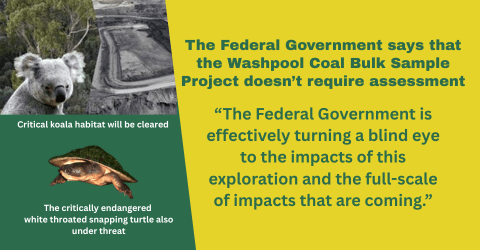
Environmental Advocacy in Central Queensland (EnvA) has expressed deep disappointment at the Federal Environment Minister Murray Watt’s decision not to assess the Washpool Coking Coal Bulk Sample Project, warning it ignores clear risks to threatened species and critical water resources.
The proposed “bulk sampling” project would extract nearly one million tonnes of coal from a site north-west of Blackwater, impacting over 150 hectares of land within a much larger 14,000 ha coal resource.
EnvA says the decision fails to recognise the project for what it is — the first stage of a much larger coal mine.
“It appears that our submission has been completely ignored,” said EnvA Director, Dr Coral Rowston.
“This is not a small, standalone project. It’s a test run for a massive new coal mine and 150ha of disturbance is significant.”
“By dismissing the need for assessment now, the Federal Government is effectively turning a blind eye to the impacts of this exploration and the full-scale of impacts that are coming.”
The project area includes habitat for numerous nationally listed threatened species, including the koala, greater glider and the critically endangered white-throated snapping turtle. Surveys have already confirmed their presence in and around the site.
EnvA says even this initial stage risks fragmenting habitat, restricting wildlife movement, and degrading ecosystems already under pressure.
“This decision ignores the reality on the ground — threatened species are already there, and their habitat is already under strain,” Dr Rowston said.
Concerns have also been raised about impacts to water resources in the Mackenzie River catchment, part of the Fitzroy Basin – the largest catchment flowing to the Great Barrier Reef. The project sits upstream of Bedford Weir which a key water resource for agriculture, industry and local communities.
EnvA warns that risks to water quality, altered flow regimes, and cumulative impacts from surrounding coal mines have not been properly assessed.
“We’re seeing a pattern where coal projects are broken into smaller pieces to avoid proper scrutiny,” Dr Rowston said.
“That approach completely undermines national environment laws and prevents the community from understanding the true scale of impacts.”
“Projects that threaten endangered species and vital water resources should be properly assessed – not waved through.”
EnvA is calling for urgent reform to ensure that projects which impact on matters of national environmental significance are assessed in full.
 EnvA - CQ