Environmental Advocacy in Central Queensland (EnvA) has called on the Federal Environment Minister to reject the proposed Blackwater Mine Northern Extension Project, warning the massive coal mine expansion would cause unacceptable environmental harm and lock in decades of additional greenhouse gas emissions.
In a submission to the Federal Government under the Environment Protection and Biodiversity Conservation Act 1999 (EPBC Act), EnvA argued the proposal would significantly impact threatened species, water resources and climate-sensitive ecosystems including the Great Barrier Reef.
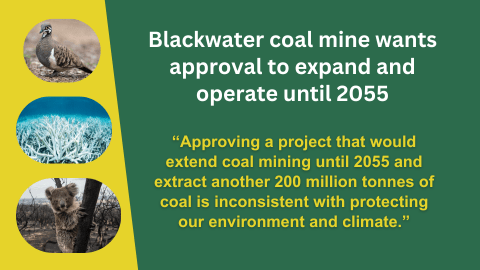
The proposal by Whitehaven Blackwater Pty Ltd would extend the life of the Blackwater Mine from 2029 until 2055, increase coal production to up to 19 million tonnes per year and facilitate the extraction of an additional 200 million tonnes of coal.
EnvA Director Dr Coral Rowston said the project represented another major expansion of coal mining in the Bowen Basin at a time when communities were already experiencing worsening climate impacts.
“Central Queensland communities are already seeing more severe heatwaves, flooding, bushfires and extreme weather driven by climate change,” Dr Rowston said.
“Approving a project that would extend coal mining until 2055 and extract another 200 million tonnes of coal is completely inconsistent with protecting our environment and climate.”
EnvA’s submission highlights significant impacts on threatened species and ecological communities, including the destruction of endangered Brigalow habitat, koala habitat and habitat for the vulnerable squatter pigeon and endangered Australian painted snipe.
The group also raised concerns about impacts on groundwater and surface water systems, including the release of mine-affected water into the Fitzroy Basin catchment which ultimately flows to the Great Barrier Reef.
“The Bowen Basin has already experienced extensive land clearing, habitat fragmentation and cumulative impacts from decades of coal mining,” Dr Rowston said.
“This project cannot be assessed in isolation. Every new expansion further chips away at wildlife habitat, water resources and ecosystem resilience.”
EnvA also argued that greenhouse gas emissions from the project, including downstream emissions from burning the coal overseas, should be assessed as impacts on matters of national environmental significance under the EPBC Act.
The organisation said the Federal Government had previously recognised similar climate-related impacts and controlling provisions in earlier referrals connected to the Blackwater Northern Extension Project.
EnvA has urged the Minister to determine that the project would have clearly unacceptable impacts. In the alternative, the group is calling for a full Environmental Impact Statement assessment under the bilateral agreement with the Queensland Government.
“Projects of this scale should face the highest level of environmental scrutiny,” Dr Rowston said.
“The community deserves a transparent assessment of the long-term impacts this project would have on biodiversity, water resources and our climate.”

