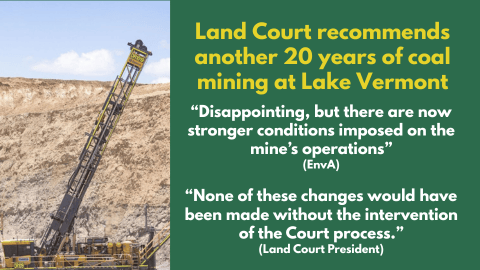
Environmental Advocacy in Central Queensland (EnvA) says the Queensland Land Court’s decision to recommend approval of the Lake Vermont Meadowbrook coal mine extension highlights the continuing challenge of reconciling new coal development with climate and environmental protection.
The Land Court today recommended that Bowen Basin Coal Pty Ltd’s environmental authority for the Lake Vermont Meadowbrook Project be approved, allowing the existing Lake Vermont coal mine near Dysart to extend its productive life by approximately 20 years.
The decision follows objections from Environmental Advocacy in Central Queensland (EnvA) and the Queensland Conservation Council over the proposed extension.
EnvA’s submission to the project’s Environmental Impact Statement raised concerns about the scale of habitat disturbance, impacts on threatened species and ecological communities, greenhouse gas emissions, climate change, offsets, rehabilitation, groundwater and surface water impacts.
The submission pointed to the proposed disturbance of hundreds of hectares of habitat, including habitat for the endangered koala and greater glider and the threatened ornamental snake, as well as endangered brigalow and other threatened vegetation communities.
EnvA also argued that the project’s greenhouse gas emissions had not been adequately addressed.
The EIS estimated that Scope 1 emissions from the Meadowbrook extension alone could reach more than 829,000 tonnes of CO₂-e in a single year. Average annual Scope 1 emissions from the extension were estimated at more than 303,000 tonnes, while combined emissions from the existing Lake Vermont mine and the extension were estimated to average more than 552,000 tonnes per year.
EnvA argued that these emissions would make Queensland’s efforts to meet its emissions reduction targets more difficult and that the project would contribute to climate impacts affecting Central Queensland, including extreme weather, threatened species and the Great Barrier Reef.
The organisation also raised concerns about the project’s proposed biodiversity offsets, arguing that protecting existing vegetation elsewhere on the property did not adequately compensate for the loss and fragmentation of habitat caused by mining.
Court recommends approval
In her judgment, Land Court President PG Stilgoe OAM concluded that the final revised environmental authority adequately addressed the issues raised and recommended that it be approved.
The Court accepted that the project would produce greenhouse gas emissions but found that they were largely regulated through the Safeguard Mechanism and a greenhouse gas abatement plan.
The Court also concluded that the project’s impacts on human rights, including cultural rights, were justified, despite the project’s contribution to GHG emissions.
Court process results in stronger conditions
Despite the outcome, the judgment makes clear that the court process resulted in changes to the proposed environmental authority.
The Court noted that the expert reports submitted during the proceedings were more comprehensive than those contained in the original EIS.
It also noted that experts recommended changes to the draft environmental authority which were accepted by Bowen Basin Coal and the Queensland Department of Environment, Tourism, Science and Innovation.
Importantly, the Court said Bowen Basin Coal undertook an extensive analysis of its gas drainage system which resulted in a proposal expected to significantly reduce fugitive emissions.
Changes to conditions
Of note, the revised conditions now include:
- A greenhouse gas abatement plan including public reporting every two years,
- Improvements to the proposed progressive rehabilitation and closure plan,
- The construction of all levees before operational works commence,
- Improvements to the groundwater monitoring conditions, and
- The preparation of a Social Impact Management Plan.
The judgment states that these changes would not have been made without the intervention of the Court process.
The environmental authority now requires a greenhouse gas abatement plan for the Meadowbrook project before mining begins. The plan must include specific requirements for emissions reduction, be reviewed every two years and be complied with as a condition of the environmental authority.
The approval conditions also require extensive monitoring and management of groundwater-dependent ecosystems, including baseline monitoring, water quality and groundwater monitoring, subsidence trigger thresholds and measures to respond if environmental harm is detected.
EnvA: decision does not remove environmental concerns
EnvA says the decision does not diminish the significance of the environmental and climate issues it raised during the assessment process.
“The Land Court has recommended that the project proceed, but that does not mean the environmental concerns raised about another 20 years of coal mining have disappeared,” EnvA Director, Dr Coral Rowston said.
“Central Queensland is already experiencing the impacts of climate change, while threatened ecosystems and species continue to face habitat loss and fragmentation.
“The decision demonstrates that these impacts can be recognised in the assessment process, but it also highlights the difficulty of protecting the environment when approval systems continue to allow new and expanded coal mines to proceed.”
EnvA says the judgment is particularly significant because it demonstrates that community objections can lead to changes in the conditions imposed on major mining projects.
“The Court has acknowledged that the process resulted in more comprehensive evidence and stronger environmental authority conditions, including a more detailed and measurable approach to greenhouse gas abatement and additional requirements for monitoring groundwater-dependent ecosystems and subsidence,” Dr Rowston said.
“That is an important outcome of community participation in environmental decision-making.”
However, EnvA remains concerned that the approval will allow the continued extraction and burning of large quantities of coal at a time when Australia and Queensland are seeking to reduce greenhouse gas emissions.
“The fundamental issue remains whether extending the life of coal mines is compatible with the scale and urgency of the climate response required,” Dr Rowston said.
“Every new coal project adds to the environmental pressures facing Central Queensland and makes the transition to a safer climate more difficult.
“While we respect the Court’s decision, EnvA will continue to advocate for development that protects Central Queensland’s environment, water resources, threatened species and communities for current and future generations.”
The Land Court’s recommendation will now proceed to the administering authority under the Queensland Environmental Protection Act.
 EnvA - CQ