Environmental Advocacy in Central Queensland (EnvA) is warning that proposed changes to Queensland’s mining laws could significantly reduce the ability of communities and environmental organisations to have major mining decisions independently scrutinised by the Queensland Land Court.
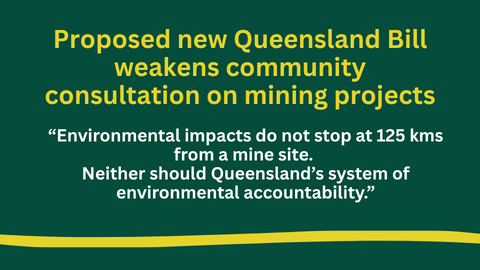
The Mineral Resources and Other Legislation Amendment Bill 2026 would narrow who can formally object to mining lease applications, introduce a 125-kilometre geographical eligibility test and make referral of objections to the Land Court dependent on a decision by the Resources Minister.
EnvA says these changes risk weakening one of the most important safeguards available to Queensland communities when confronting large-scale mining proposals.
“Community members and organisations can spend months reviewing thousands of pages of technical information, identifying risks and preparing detailed objections,” EnvA said.
“They should not then be told that their concerns cannot receive independent scrutiny simply because they do not meet an arbitrary geographical test or because a Minister chooses not to refer the matter to the Land Court.”
EnvA’s experience demonstrates that Land Court proceedings can make a tangible difference even when a project ultimately proceeds.
At Sonoma, the Land Court recommended stronger greenhouse gas accountability.
At Rolleston, the Court noted that extensive evidence had been provided that was not available when the draft environmental authority was originally notified, enabling more comprehensive consideration of the proposal.
At Ensham, the Court identified significant concerns about greenhouse gas emissions and recommended against approval unless meaningful progress was made on emissions mitigation.
In the Blue Energy matter, EnvA’s appeal resulted in a revised environmental authority and a substantial reduction in the proposed gas development.
At Lake Vermont, the Land Court process resulted in changes to environmental and rehabilitation requirements, including requirements relating to greenhouse gas emissions, groundwater, levees and social impacts.
Most recently, in the Coppabella matter, the Court recommended approval of an amended environmental authority while the proceedings resulted in stronger requirements concerning groundwater, dust, biodiversity, threatened species habitat, rehabilitation, residual voids, incident reporting and Aboriginal input into post-mining outcomes.
“These cases demonstrate that the value of community objection rights cannot be measured simply by whether a project is approved or refused,” EnvA Director Dr Coral Rowston said.
“Independent scrutiny can test evidence, identify deficiencies and result in stronger conditions being imposed on projects that may operate for decades.”
EnvA is particularly concerned that environmental impacts do not necessarily stop at the boundary of a mine or within a 125-kilometre radius.
Greenhouse gas emissions contribute to global climate change. Impacts on threatened species, water resources and ecological communities can extend well beyond individual mine sites. Cumulative impacts can also arise across entire catchments and regions.
“Environmental impacts do not stop at 125 kilometres. Neither should Queensland’s system of environmental accountability.”
EnvA is calling for the Bill to be withdrawn or substantially amended to preserve meaningful community objection rights and independent access to the Queensland Land Court.

