Environmental group says global climate action must include a significant reduction in new and expanding coal and gas developments
As world leaders gather in Türkiye for COP31, Environmental Advocacy in Central Queensland (EnvA) is calling for stronger global action to address the continued expansion of coal and gas developments, including in the Bowen and Galilee Basins.
EnvA says governments cannot credibly claim to be addressing climate change while continuing to approve new fossil fuel developments and expansions, and facilitating increasing volumes of coal exports.
The 31st United Nations Climate Change Conference (COP31), being held in Antalya from 9–20 November, provides an opportunity for countries to move beyond climate commitments and take meaningful action to reduce global emissions.
But for communities in Central Queensland, the contradiction between climate promises and fossil fuel approvals is becoming increasingly difficult to ignore.
The region continues to experience proposals for new and expanded coal mines, while existing operations are approved to extract coal for decades to come.
The recent approval of BHP’s Grevillea Pit continuation project at the Saraji Mine near Dysart, allowing a further 55 million tonnes of coal to be extracted through to 2055, is a clear example of this ongoing expansion.
EnvA Director Dr Coral Rowston said it was time for governments to acknowledge that approving additional fossil fuel developments was fundamentally inconsistent with the urgent need to reduce global greenhouse gas emissions.
“Climate change doesn’t stop at Australia’s borders, and neither do the emissions from the coal and gas we export.
“It doesn’t matter whether coal is burnt in Central Queensland, China, India, Japan or anywhere else in the world. Once it is burnt, it releases greenhouse gases into the atmosphere and contributes to global warming.
“We cannot simply exclude overseas emissions from our climate responsibilities because the pollution occurs somewhere else. The atmosphere doesn’t distinguish between Australian coal and coal from any other country.”
Dr Rowston said Central Queensland had a particularly important role to play in the global climate debate because of the concentration of coal and gas developments across the region.
“Central Queensland is on the frontline of Australia’s fossil fuel industry. We see the mines, the gas developments, the clearing of habitat, the impacts on our waterways and the infrastructure required to extract and export these resources.
“But we also have communities that are increasingly exposed to the consequences of climate change, including more intense heat, extreme weather events, flooding and pressure on our natural environment.
“These impacts are not abstract international issues. They affect our local communities, our agricultural industries, our waterways, our natural assets and our future.”
Dr Rowston said COP31 needed to deliver more than ambitious statements and emissions reduction targets.
“One of the most important actions governments can take is to significantly reduce the approval and development of new and expanding coal and gas projects.
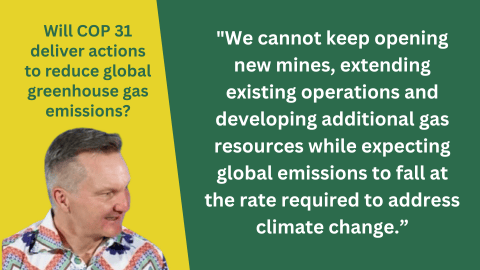
“We cannot keep opening new mines, extending existing operations and developing additional gas resources while expecting global emissions to fall at the rate required to address climate change.
“Reducing emissions from existing operations is important, but it is not a substitute for reducing the amount of fossil fuels being developed and ultimately burnt.”
EnvA is calling on Australian governments to demonstrate greater consistency between their international climate commitments and domestic resources policies, including decisions about new coal mines, mine expansions and gas developments.
“Central Queensland has contributed enormously to Australia’s resources economy. But we need to be honest about the long-term environmental and climate consequences of continuing to expand fossil fuel production.
“COP31 must be about turning commitments into action. That means confronting fossil fuel expansion, not continuing to approve it while the world discusses how to reduce emissions.
“We need a future where regional communities have genuine opportunities to diversify their economies and build prosperity without becoming increasingly dependent on industries that are contributing to the climate crisis.”

