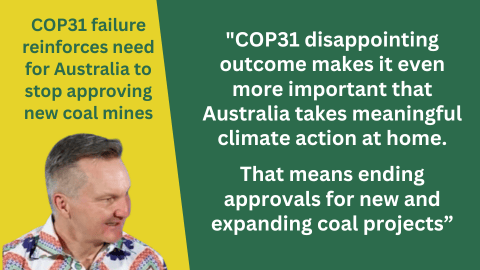
The disappointing failure of COP31 to reach agreement on stronger climate action must be a wake-up call for the Australian Government, particularly given its role in leading the international negotiations.
Environmental Advocacy in Central Queensland (EnvA) says Australia must demonstrate genuine climate leadership by stopping approvals for new and expanding coal mines, rather than continuing to promote fossil fuel developments that create environmental damage, insecure employment and growing rehabilitation liabilities.
Negotiations at COP31 broke down over the failure to explicitly acknowledge fossil fuels in the proposed outcome, despite strong calls from many countries for a commitment to transition away from coal, oil and gas.
EnvA Director Dr Coral Rowston said Australia could not credibly claim international climate leadership while continuing to approve new coal developments at home.
“The science is clear. We cannot meet global emissions reduction targets while continuing to develop new fossil fuel projects. Australia must lead by example and start planning for a future beyond coal.”
Dr Rowston said the financial difficulties experienced by a growing number of Central Queensland coal companies demonstrated that continued coal development was no guarantee of secure employment or economic prosperity.
The region has already experienced significant disruption from coal industry failures and restructuring.
Bowen Coking Coal entered administration in 2025, placing jobs, contractors and creditors at risk. Its Bluff mine, near Blackwater, has since been abandoned after attempts to sell the operation failed, leaving the Queensland Government responsible for managing the site.
Vitrinite, which operated the Vulcan coal complex near Dysart and was developing the Callan Coking Coal project, entered administration and receivership in February 2026 with debts exceeding $400 million, including more than $16 million in employee entitlements. Its assets were subsequently sold to Indonesian mining company Ithaca Resources.
The liquidation of Hancock Coal in October 2026 has also effectively ended the prospects of its proposed Alpha coal mine, while the proposed Kevin’s Corner project remains undeveloped despite years of planning and promotion.
Financial and operational pressures are not confined to smaller operators. Anglo American’s Central Queensland steelmaking coal operations, including Moranbah North and Grosvenor, have experienced significant production disruptions and financial challenges, prompting a major ownership transition. TerraCom has faced financial and operational pressures at Blair Athol, while its proposed Moorlands development remains another potential investment in an uncertain coal market. Peabody’s Centurion mine has also experienced significant production challenges and additional costs associated with geological difficulties.
“These examples demonstrate the vulnerability of an industry exposed to volatile international coal prices, rising operating costs and changing global markets,” Dr Rowston said.
“Some operations have collapsed, others have been sold or restructured, while proposed projects have failed to progress. Workers and regional communities should not be left carrying the consequences of companies’ commercial failures or governments approving projects based on optimistic economic assumptions.”
Dr Rowston said the consequences extended well beyond lost jobs and business opportunities.
“When a mining company fails, its environmental liabilities do not disappear with it. Bluff is a very real example of a relatively young coal mine becoming an abandoned site that the Queensland Government must now manage.
“Queensland’s estimated rehabilitation risk has climbed to more than $14.5 billion. Taxpayers, landholders and communities should not be left picking up the bill when mining companies cannot meet their rehabilitation obligations.”
EnvA says governments must recognise the growing commercial risks associated with new coal developments, strengthen protections against abandoned mine liabilities and stop approving projects that could leave communities with stranded assets and unfinished rehabilitation.
Dr Rowston said Central Queensland needed a planned transition towards a more diverse and resilient regional economy, with investment in industries capable of providing secure employment into the future.
“Coal workers deserve better than promises of decades of employment, only to find themselves out of work when a company collapses or a mine becomes uneconomic.
“Governments must work with workers, unions, businesses and regional communities to develop alternative industries and employment opportunities before more jobs are lost.
“COP31’s failure makes it even more important that Australia takes meaningful climate action at home. That means ending approvals for new and expanding coal projects, supporting workers through a planned transition and ensuring communities are not left paying the environmental and financial costs of an increasingly uncertain industry.
“Central Queensland deserves a sustainable economic future, not a legacy of abandoned mines, lost jobs and unpaid rehabilitation bills.”

