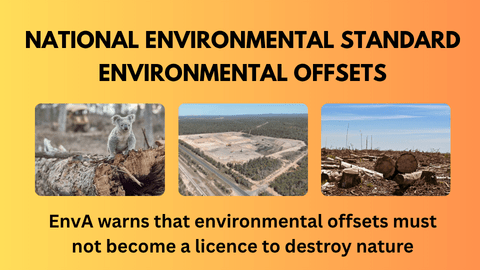
Environmental Advocacy in Central Queensland (EnvA) has called on the Federal Government to significantly strengthen its proposed Environmental Offsets Standard, warning that weak offset rules risk legitimising the continued destruction of Australia’s most important environmental assets.
In a submission on the draft Environmental Offsets Standard, EnvA argues that biodiversity offsets have consistently failed to halt environmental decline and should only ever be used as a genuine last resort after all impacts have been avoided and minimised.
EnvA Director Dr Coral Rowston said the proposed standard still contains significant weaknesses that could allow proponents to destroy Matters of National Environmental Significance while relying on offsets that may never deliver equivalent environmental outcomes.
“Australia’s biodiversity continues to decline despite more than a decade of offset policies operating across the country,” Dr Rowston said.
“Offsets are often presented as a solution, but in reality, they frequently fail to replace the habitat, ecological connectivity and ecosystem functions that are permanently lost when development proceeds.”
EnvA is particularly concerned about provisions that would allow proponents to pay into offset funds when suitable offsets cannot be secured.
“Damage and destruction of nationally important environmental values should not be for sale,” Dr Rowston said.
“If a proponent cannot identify and secure a suitable offset, that is a clear indication that the impacts cannot be adequately compensated. In those circumstances, the project should not be approved.”
EnvA has also criticised provisions that only require offsets to be protected for limited periods.
“Temporary protection cannot compensate for permanent habitat loss. If habitat is permanently destroyed, any offset intended to compensate for that loss must be protected and managed in perpetuity.”
EnvA has recommended that the Federal Government strengthen the standard by:
🍃 replacing discretionary language such as ‘should’ with mandatory requirements;
requiring offset sites to be legally secured and managed in perpetuity;
🍃 refusing projects where suitable offsets cannot be secured;
🍃 removing indirect offsets that rely on research, education or other measures instead of habitat protection; and
🍃 eliminating offset fund arrangements that allow proponents to pay in lieu of securing genuine offsets.
“The Samuel Review made it clear that Australia’s environmental laws have failed to stop environmental decline,” Dr Rowston said.
“If the new Environmental Offsets Standard is to play a meaningful role in environmental recovery, it must prioritise avoidance of impacts and genuine conservation outcomes rather than facilitating ongoing habitat loss through compensatory mechanisms.”
 EnvA - CQ
One thought on “EnvA warns environmental offsets must not become a licence to destroy nature”