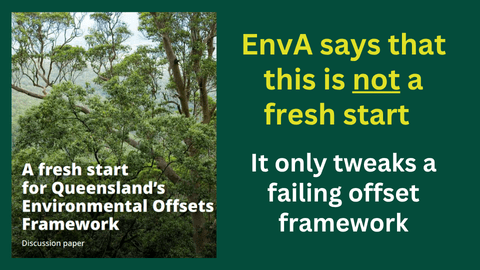
Environmental Advocacy in Central Queensland (EnvA) has called for a fundamental overhaul of Queensland’s environmental offsets framework, warning that the current system is a “pay-to-destroy” model that is failing to protect biodiversity and threatened species.
In its submission to the Queensland Government’s review of the Environmental Offsets Framework, EnvA argues that proposed reforms do not represent the “fresh start” promised in the discussion paper, instead focusing on administrative changes to the current framework while ignoring the deeper failures of the offsets system itself.
EnvA Director, Dr Coral Rowston, said the state’s offset framework was not delivering the conservation outcomes it was designed to achieve.
“Queensland’s biodiversity continues to decline despite more than a decade of environmental offsets policy. We need to ask whether the system is actually working, not just how to make it run more efficiently,” Dr Rowston said.
“Offsets were supposed to compensate for unavoidable environmental damage, but in practice they have become a licence to destroy habitat while promising benefits elsewhere that may never fully materialise.”
EnvA said one of the most concerning findings in the discussion paper is that more than 90% of offset obligations have been discharged through financial payments rather than direct, land-based conservation actions.
“Developers are overwhelmingly choosing to write a cheque instead of securing and managing genuine offsets. That is not conservation – it is a financial transaction,” Dr Rowston said.
“The government itself acknowledges that it has struggled to spend the money effectively, with more than $129 million accumulating in the offsets account while habitat continues to be cleared.”
“When habitat is destroyed, the loss is immediate. Any restoration benefits can take decades to develop, if they occur at all. During that time, species continue to decline and ecosystems become increasingly fragmented.”
The organisation has urged the Queensland Government to reduce reliance on financial settlement offsets, require proponents to secure direct offsets wherever possible, and refuse developments where suitable offsets cannot be found.
“Offsets should only ever be a last resort after all reasonable steps have been taken to avoid and minimise impacts,” Dr Rowston said.
“If a project cannot proceed without destroying important environmental values and there is no genuine way to compensate for that loss, then the project should not proceed.”
EnvA has also called for existing offset funds to be directed toward strategic, landscape-scale conservation projects that deliver measurable and lasting biodiversity benefits.
“The biodiversity crisis requires real conservation outcomes, not accounting exercises. Queensland needs an offsets framework that helps reverse environmental decline rather than gathering funds without progressing the essential onground conservation work.”
 EnvA - CQ