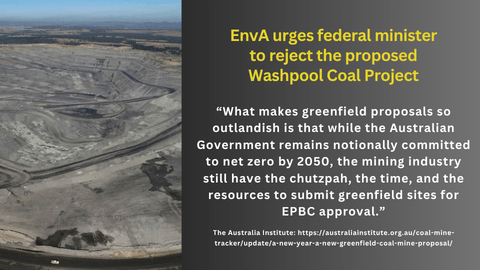
Environmental Advocacy in Central Queensland (EnvA) has called on the Federal Environment Minister to refuse the proposed Washpool Coal Project near Blackwater, describing it as an unacceptable coal mine that threatens nationally protected wildlife, water resources, the Great Barrier Reef and Australia’s climate commitments.
In a submission lodged with the Australian Government, EnvA argues the proposal should be rejected because it would clear around 7,500 hectares of land, generate an estimated 144 million tonnes of greenhouse gas emissions, and place further pressure on an already heavily impacted region of the Bowen Basin.
EnvA Director Dr Coral Rowston said the proposal fails to demonstrate that its environmental impacts can be avoided, mitigated or offset.
“The Minister has an opportunity to draw a line in the sand. This project should be refused because the environmental risks are simply too great and the information provided by the proponent is inadequate to justify further progression through the assessment process.”
The submission identifies serious concerns about impacts on threatened species, including Brigalow ecological communities, koalas, greater gliders and the white-throated snapping turtle, as well as risks to water resources flowing into the Fitzroy Basin and ultimately the Great Barrier Reef.
It also notes that the project would operate for around 20 years while producing greenhouse gas emissions equivalent to approximately 144 million tonnes of carbon dioxide, undermining Australia’s legislated emissions reduction targets.
“Approving another major greenfield coal mine is inconsistent with Australia’s commitment to reduce emissions and protect nationally significant environmental values.
“We cannot continue approving projects that add to cumulative habitat loss, increase climate pollution and place further pressure on our rivers and the Great Barrier Reef.”
EnvA says the referral itself acknowledges that further investigations are required to understand groundwater and surface water impacts, demonstrating that the environmental consequences of the project remain uncertain.
“The proponent is effectively asking the Minister to let the project proceed before the necessary background work has been completed,” Dr Rowston said.
“The precautionary approach should apply. Where there is significant uncertainty and the potential for irreversible environmental harm, the appropriate decision is to refuse the proposal.”
While EnvA’s submission recommends that, if the project is not refused, it should at least be declared a controlled action requiring a full Environmental Impact Statement, the organisation says its primary position is clear.
“This project fails the environmental test. The Minister should reject it.”

