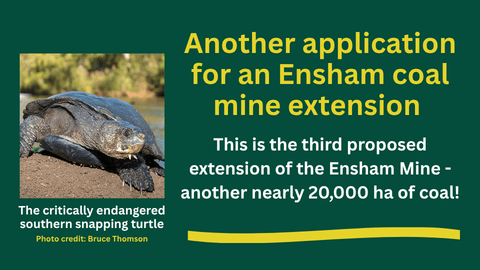
Environmental Advocacy in Central Queensland (EnvA) is urging Federal Environment Minister Murray Watt to reject a proposed nine-year extension of the Ensham coal mine near Emerald, warning of significant risks to threatened species, water resources and the climate.
The Ensham Life of Mine Extension 2 would extend underground mining operations from the currently forecast closure in 2037 through to 2045, with production of up to approximately 6.5 million tonnes of run-of-mine coal per year.
EnvA’s submission on the project’s referral under the Environment Protection and Biodiversity Conservation Act 1999 (EPBC Act) says the proposal has the potential to affect numerous threatened species and ecological communities, including koalas, greater gliders, squatter pigeons, ornamental snakes, grey snakes, southern snapping turtles and Fitzroy River turtles.
Several endangered ecological communities have also been identified as potentially affected, including Brigalow, Natural Grasslands of the Queensland Central Highlands and northern Fitzroy Basin, Poplar Box Grassy Woodland and Weeping Myall Woodlands.
EnvA says the referral documentation is based on a preliminary ecological assessment and previous ecological assessments undertaken in 2019, with comprehensive ecological surveys and assessments of potential impacts yet to be completed.
The organisation also raised concerns about potential impacts on surface and groundwater, groundwater-dependent ecosystems and aquatic ecosystems.
“The lack of detailed information on water resources makes it difficult to properly assess the significance of the potential impacts,” EnvA Director Dr Coral Rowston said.
EnvA is also concerned about the greenhouse gas emissions associated with extending the life of the mine, particularly given the high methane emissions associated with Ensham.
The organisation notes that the Queensland Land Court previously criticised the mine’s lack of progress in implementing measures to mitigate greenhouse gas emissions, recommending that the previous extension should not proceed unless the applicants demonstrated “real and significant progress” towards reducing emissions.
EnvA has called on Minister Watt to determine that the project would have clearly unacceptable impacts on protected matters.
Alternatively, it says the project should be declared a controlled action under the EPBC Act for threatened species and ecological communities, migratory species and water resources, with a full environmental impact statement required.
“Central Queensland has already experienced extensive habitat loss, pressure on water resources and the growing impacts of climate change,” Dr Rowston said.
“Extending the life of another thermal coal mine until 2045 would add to those pressures and requires rigorous assessment of the cumulative environmental and climate impacts.”
EnvA’s submission also argues that the proposed extension has not established a compelling justification for continuing coal mining beyond the currently approved mine life.
The organisation is urging the Federal Government to refuse the project and prioritise protection of Central Queensland’s biodiversity, water resources and climate.
 EnvA - CQ