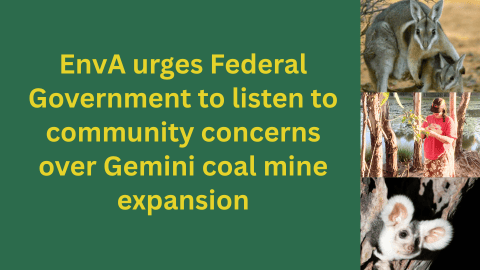
Environmental Advocacy in Central Queensland (EnvA) is calling on the Federal Environment Minister and National Environmental Protection Agency (National EPA) to reconsider their assessment approach for the proposed Gemini Coal Mine Extension and associated rail loop, warning that community concerns must not be dismissed and major projects must receive thorough environmental scrutiny.
In a letter to Federal Environment Minister Murray Watt and National EPA Chief Executive Officer John Bradley, EnvA has raised serious concerns about decisions to assess the two proposals through preliminary documentation rather than a more comprehensive Environmental Impact Statement (EIS) or Public Environment Report (PER).
EnvA is also questioning the apparent conclusion that the projects are likely to attract a low level of public interest, despite more than 15 years of community concern and opposition to mining proposals in the area.
“The history of Dingo West, Walton and Gemini demonstrates that these proposals have never been without controversy,” said EnvA Director Dr Coral Rowston.
“Local landholders, Ghungalu Traditional Owners, tourism operators and conservation organisations have repeatedly raised concerns about the impacts of mining in this area. It is difficult to understand how a project with this history can reasonably be considered to attract little public interest.”
The proposed mine extension would enable extraction of up to 1.9 million tonnes of metallurgical coal annually, with EnvA identifying potential impacts across approximately 755 hectares of habitat.
The project is immediately adjacent to Taunton National Park, home to Australia’s last naturally occurring population of the endangered bridled nail-tail wallaby. Other environmental values potentially at risk include habitat for greater gliders and koalas, threatened ecological communities, wetlands, waterways and groundwater-dependent ecosystems.

EnvA is particularly concerned that the preliminary documentation process does not provide the level of independent scrutiny, transparency and public participation warranted by a development of this scale and complexity.
“Environmental assessment should not be about finding the quickest or easiest pathway for a project to proceed. It should be about properly understanding the risks, examining the evidence and giving the community a meaningful opportunity to have its concerns heard,” Dr Rowston said.
EnvA has also questioned the decision to accept separate Commonwealth referrals for the mine extension and rail loop.
Both proposals are being advanced by the same proponent and form closely connected components of the broader Gemini mining and coal export operation. Assessing them separately risks overlooking cumulative impacts and understating the overall environmental footprint.
“Government must look at the bigger picture. A mine and the infrastructure needed to transport its coal should not be assessed in isolation if doing so risks overlooking the combined impacts of the development.”
EnvA’s concerns are not new. The original Dingo West proposal dates back to 2010–2011 and was subject to a Queensland Government determination requiring an EIS, although that assessment was never completed. Subsequent proposals in the area, including Walton and Gemini, have continued to attract opposition.
More recently, concerns have included vegetation clearing, impacts on Country and cultural heritage, and the presence of endangered greater gliders at the proposed mine site.
EnvA is asking the Minister and National EPA to reconsider the assessment pathway and require an EIS, or at a minimum a PER, review the conclusion that public interest is low, and examine whether the mine extension and rail loop should be treated as components of a larger development.
The organisation is also calling for comprehensive assessment of the combined and cumulative impacts, meaningful opportunities for public and Traditional Owner participation, and greater transparency around the decisions already made.
“The establishment of the National EPA provides an opportunity to restore public confidence in environmental decision-making. That confidence will depend on communities being listened to and environmental assessments being thorough, independent and evidence-based.
“Communities should not have to repeatedly raise the same concerns only to find that decisions are made without adequately recognising their history or giving proper consideration to the environmental values at stake.
“We urge the Federal Government and National EPA to take these concerns seriously and ensure the Gemini development receives the level of scrutiny it warrants.”

